

Stepping through the towering bronze doors of the Pantheon on a chilly December morning.
My temptation: hurry inside one of the world’s oldest, fully intact buildings. Snap a few cell-phone photos and leave.
Instead, I stop and study the immense doorway. My gaze falls on a deep gouge in the bronze doorframe. I run my fingers over the rough edge of the damaged metal.
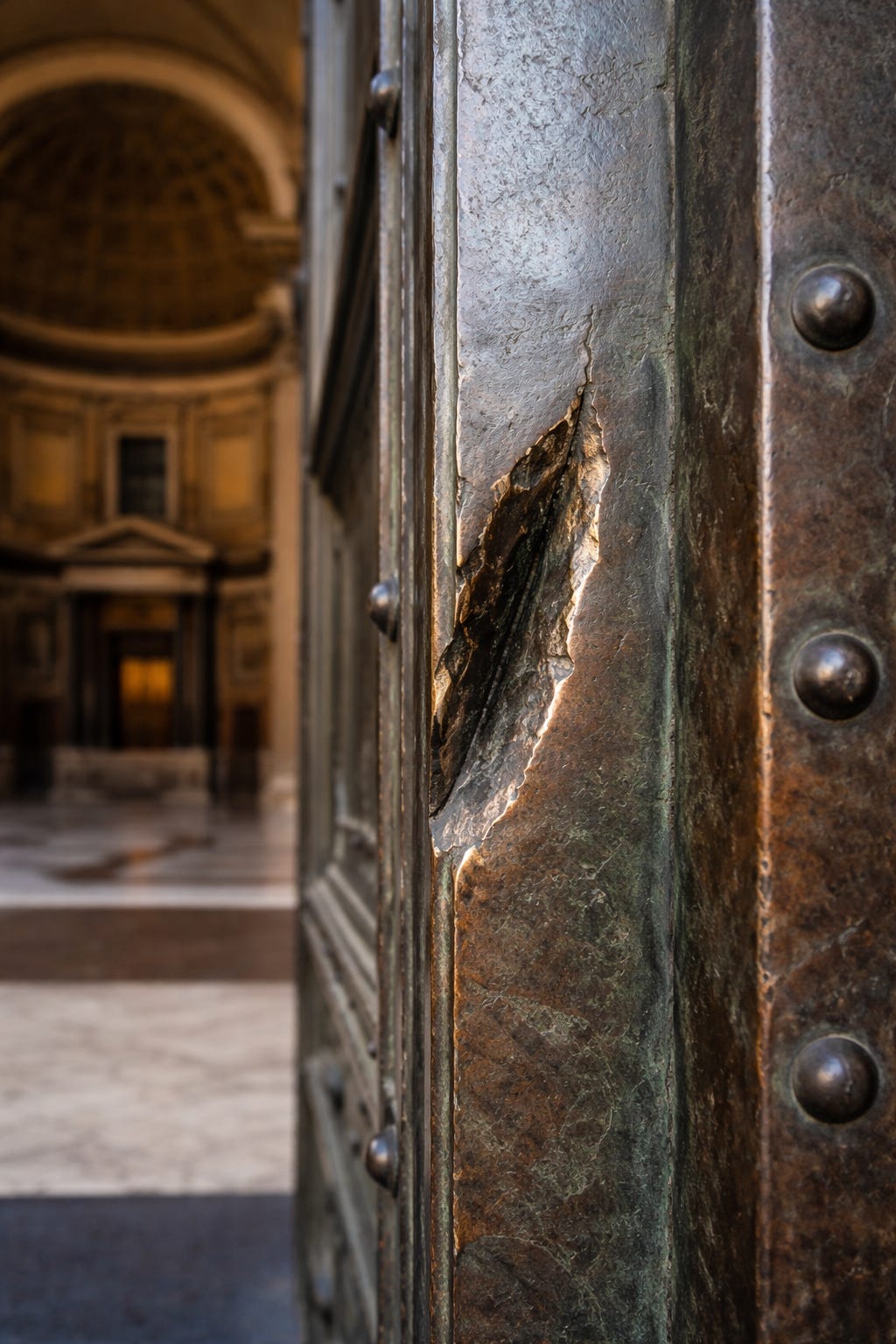
These bronze doors have stood here for nearly two thousand years, long enough to watch empires rise and fall around them.
The damage likely stems from attempts to pry bronze from the doors, probably sometime after the fall of the Western Roman Empire in 476 AD.
In the centuries that followed, invaders and scavengers often stripped Roman buildings for valuable materials. Bronze was one of the most prized metals of the ancient and medieval worlds.
The Pantheon and its magnificent oculus itself survived largely because it was converted into a Christian church in 609 AD. Buildings that remained in use were far less likely to be dismantled for their materials.
Copper alloys such as bronze and brass circulated widely in the Roman economy. Coins such as the as, dupondius, and sestertius passed through countless hands across the empire.
The Pantheon’s bronze doors and frame could be melted down to fashion weapons, coins, tools, and ship fittings. Ancient buildings were often stripped of valuable metals.
In 1625, Pope Urban VIII ordered bronze removed from the portico ceiling of the Pantheon to make cannons and the baldachin inside St. Peter’s Basilica.
Romans joked, “What the barbarians could not do, the Barberini did.” (The Barberini were Urban VIII’s family.)
But the Pantheon’s massive bronze doors proved too difficult to remove.
The doors measure about 23 feet high and weigh several tons. Enormous stone frames anchor them in the entrance.
A looter likely tried to pry or break bronze fittings loose, leaving the gouges we see today.
Many historians suspect the damage occurred sometime between 500 and 1000 AD, during the Early Middle Ages. Rome’s population collapsed, imperial authority evaporated, and many Roman buildings were stripped for materials.
No historical record tells us exactly when the doorway was damaged.
A careful observer can still see the gouges.
Nearly two millennia after the Pantheon was built under Hadrian in 125 AD, a failed attempt to steal its bronze still marks the doorway.
The looters failed.
The scars remain.
If you enjoy small details from places where history still lingers, consider subscribing. I write about time, memory, and the stories tucked into old places
The Pantheon doors themselves are original Roman bronze.
Nearly 2,000 years old… and still opening and closing every day.